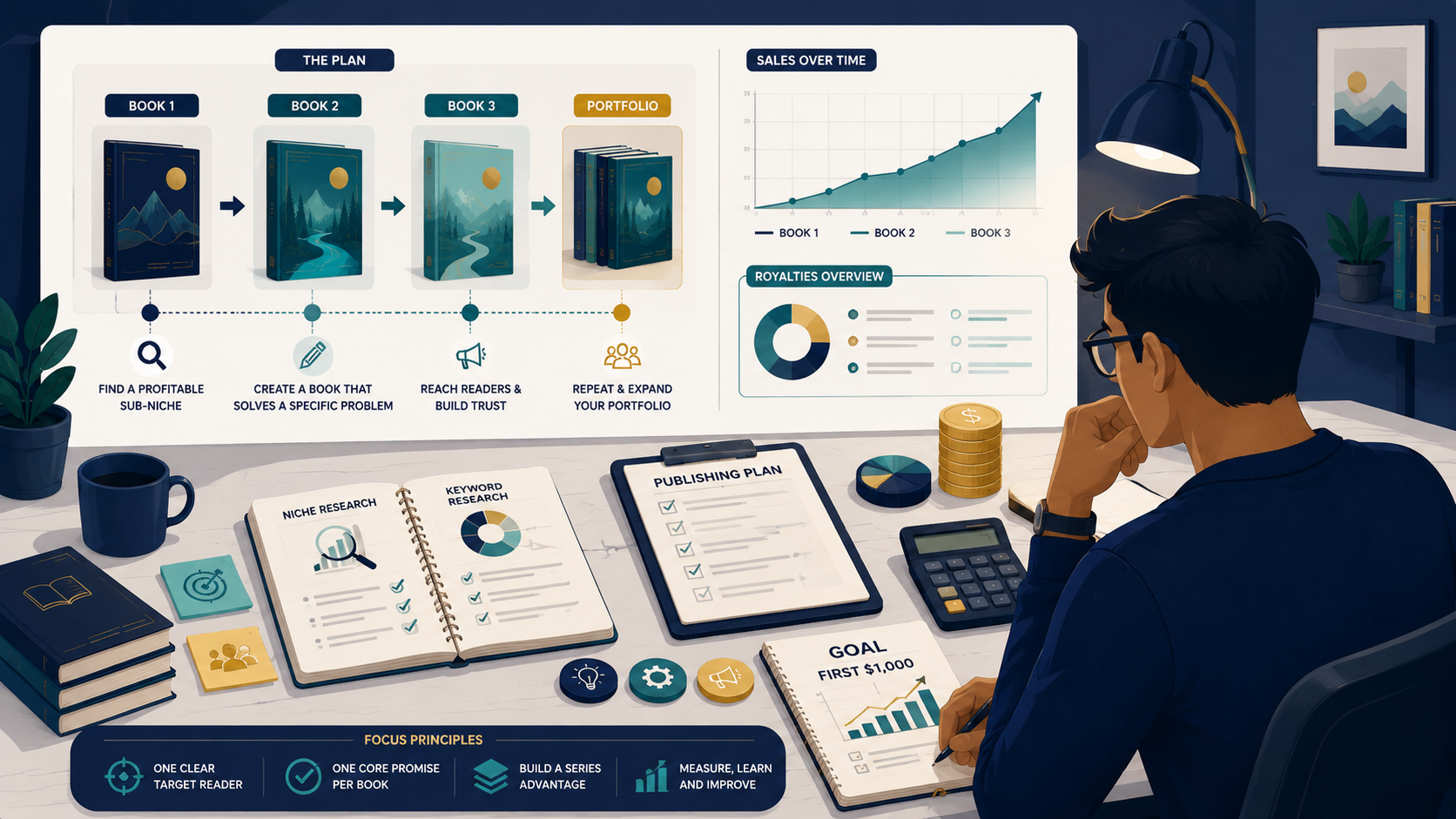
Your first $1,000 in Amazon KDP royalties could come from one book selling hundreds of copies, four related books making steady sales or a larger catalogue producing occasional orders over time.
Those routes are not equally likely.
They also do not require the same amount of money, time, skill or risk.
Many new publishers begin with the question:
What kind of book can make me $1,000?
That question encourages them to chase individual book ideas, copy whatever appears popular and publish without knowing how many sales they actually need.
A more useful question is:
What small publishing portfolio could realistically generate enough royalty-producing sales to reach a cumulative $1,000?
This article will not give you a guaranteed formula. No honest publishing strategy can promise a particular income.
Instead, you will learn how to turn the goal into numbers, choose a realistic portfolio model and test one audience before investing months in a large catalogue.
First, Decide What “Your First $1,000” Actually Means
There are several very different goals that people casually describe as “making $1,000 on KDP.”
You might mean:
- $1,000 in total royalties since you began;
- $1,000 in royalties during one month;
- $1,000 in payments received in your bank account;
- $1,000 in revenue before expenses;
- $1,000 in actual profit after expenses.
These are not interchangeable.
For a first milestone, this article focuses on:
Earning a cumulative $1,000 in royalties from a small portfolio of books.
That is a more useful beginner target than expecting to reach $1,000 every month immediately.
It also separates your first proof of demand from the more difficult challenge of building stable monthly income.
Remember that royalties earned and money received are not recorded at the same time. KDP states that royalties are generally paid approximately 60 days after the end of the month in which a sale was reported, provided any applicable payment threshold has been met.
Therefore, reaching $1,000 in reported royalties does not necessarily mean $1,000 will enter your bank account immediately.
Revenue, Royalties and Profit Are Different Numbers
Suppose customers buy $4,000 worth of your books.
That does not mean you earned $4,000.
Amazon deducts its share and, for print books, the cost of producing each copy. What remains is your royalty.
You may then have expenses such as:
- editing;
- cover design;
- illustrations;
- research software;
- proof copies;
- advertising;
- fonts or licensed assets;
- formatting assistance;
- currency-conversion or banking costs.
Your simplified calculation is:
Profit = KDP royalties − publishing and marketing expenses
A publisher who receives $1,000 in royalties after spending $100 has produced a very different result from one who spent $1,400 to generate the same amount.
Your first-$1,000 plan should therefore track two targets:
- cumulative royalties;
- cumulative profit.
Reverse-Engineer the Number of Sales You Need
The basic calculation is simple:
Target royalties ÷ average royalty per sale = sales required
Suppose your target is $1,000.
If you earn an average royalty of $2 per copy:
$1,000 ÷ $2 = 500 sales
At $4 per copy:
$1,000 ÷ $4 = 250 sales
At $5 per copy:
$1,000 ÷ $5 = 200 sales
At $8 per copy:
$1,000 ÷ $8 = 125 sales
This is why the phrase “I want to make $1,000” is incomplete. The difficulty of reaching the target depends heavily on how much each sale contributes.
For paperbacks, KDP calculates royalty using the applicable royalty rate multiplied by the list price, minus printing costs. The royalty rate can also depend on the book’s price and marketplace. KDP provides a current calculator for estimating royalties before publication.
You should use the royalty estimate for your actual:
- marketplace;
- page count;
- ink type;
- trim size;
- list price;
- distribution option.
Do not build your plan around a royalty amount borrowed from someone else’s book.
Why Page Count and Format Change the Plan
Two books sold at the same price may not produce the same royalty.
A 120-page black-and-white paperback may cost less to print than a 250-page colour paperback. The second book could have a higher retail price while still producing a lower royalty.
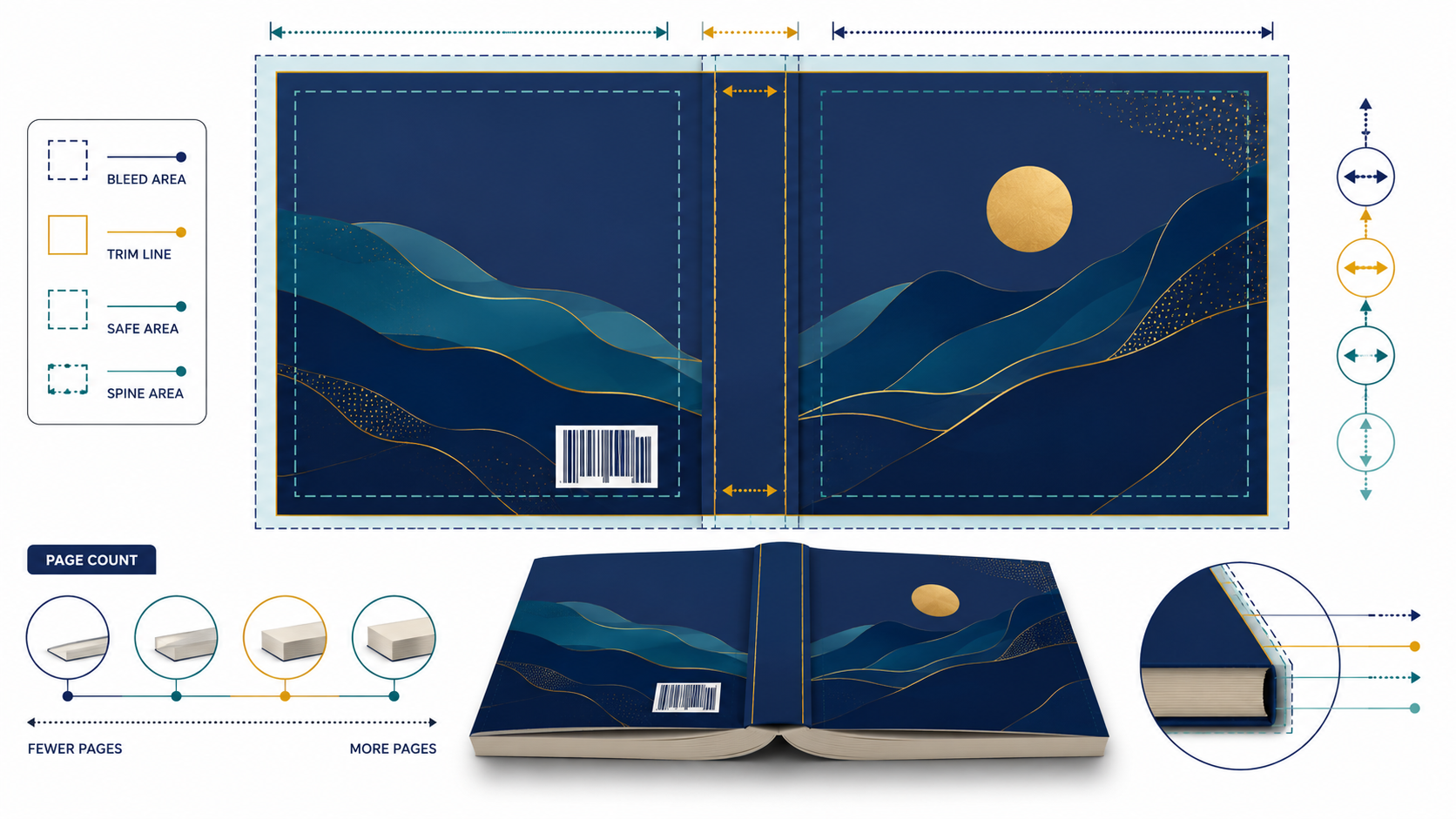
KDP states that paperback printing costs vary according to the marketplace, page count and ink type. Trim size, bleed setting and cover finish do not directly affect the printing cost.
This creates an important planning lesson:
Do not choose the book format first and calculate profitability later.
Estimate the following before producing the full manuscript:
- likely final page count;
- black-and-white or colour interior;
- realistic list price;
- estimated printing cost;
- royalty per sale;
- expected production cost;
- number of sales required to break even.
A beautiful book can still be a poor commercial project when its production cost forces the price beyond what its audience is willing to pay.
Four Possible Routes to Your First $1,000
There is no single correct portfolio size. However, comparing a few models helps reveal what each route demands.
These examples assume an average royalty of $4 per sale.
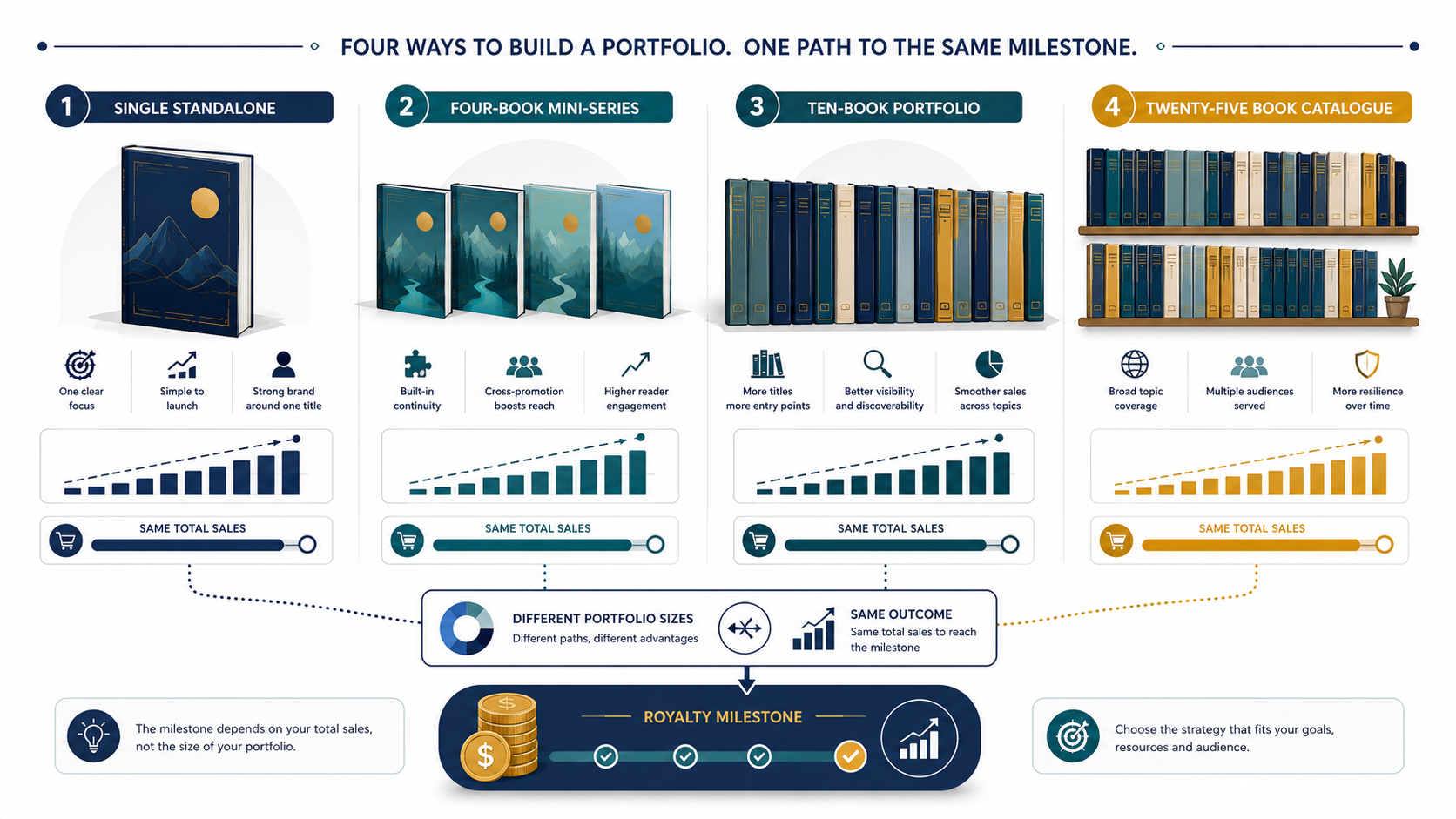
| Portfolio model | Number of books | Sales needed per book | Total sales | Estimated royalties |
|---|---|---|---|---|
| One breakout book | 1 | 250 | 250 | $1,000 |
| Focused mini-series | 4 | 63 | 252 | $1,008 |
| Small portfolio | 10 | 25 | 250 | $1,000 |
| Broad catalogue | 25 | 10 | 250 | $1,000 |
These are planning scenarios, not predictions.
The table shows something important: publishing more books does not remove the need for sales. It only distributes the sales requirement across more titles.
Twenty-five weak books do not automatically have a better chance than four carefully positioned ones.
Route One: Depend on One Breakout Book
The one-book route is attractive because it appears simple.
You can put all your effort into:
- one strong concept;
- one professional cover;
- one polished manuscript;
- one product page;
- one advertising campaign.
If the book connects with readers, it can reach the target without requiring a large catalogue.
The danger is concentration.
A single book can fail because:
- demand was overestimated;
- the title does not match buyer language;
- the cover attracts the wrong audience;
- the price feels too high;
- the sample does not convert;
- the niche is seasonal;
- the book receives poor early feedback;
- competing books improve.
With only one title, you have no portfolio to absorb that failure.
This route is suitable when the book requires deep expertise or substantial production quality, but it should not be your default plan simply because producing one book feels easier.
Route Two: Build a Focused Mini-Series
A focused mini-series contains several genuinely different books created for the same broader audience.
For example, a children’s question-and-answer brand might include:
- big questions about everyday science;
- big questions about space;
- big questions about animals;
- big questions about the human body.
Each book has its own subject and reason to exist, but the same reader may be interested in more than one volume.
A puzzle publisher could create:
- beginner large-print sudoku;
- easy-to-medium progressive sudoku;
- travel sudoku;
- a themed gift edition.
The advantage is not merely having more products.
You can reuse what you learn about:
- the audience;
- terminology;
- cover conventions;
- pricing expectations;
- interior structure;
- review complaints;
- marketing messages.
The focused-series route reduces dependence on one title without forcing you to research an entirely new market for every book.
“The best second book is often not a new niche. It is a better answer to another need held by the same reader.”
Route Three: Publish a Ten-Book Portfolio
A ten-book portfolio can spread risk across multiple titles, but it introduces a serious production challenge.
Each book still needs:
- a distinct reader benefit;
- a commercially understandable title;
- a professional cover;
- useful content;
- correct formatting;
- complete metadata;
- quality control.
If publishing ten books causes you to reduce research, editing or design quality, the larger catalogue may simply multiply weak decisions.
A ten-book model makes more sense after you have established:
- a repeatable creation process;
- a clear audience;
- production templates;
- reliable quality checks;
- evidence that at least one or two related angles can attract buyers.
Do not choose ten books only because the sales target looks smaller when divided across them.
Route Four: Build a Large, Broad Catalogue
A broad catalogue attempts to generate many small sales from many books.
This approach can work when the publisher has:
- efficient production systems;
- strong quality control;
- several established audiences;
- dependable research methods;
- enough time to maintain the catalogue.
For a beginner, it can create the illusion of progress.
Uploading frequently feels productive, but a large catalogue can hide problems:
- no clear publishing identity;
- duplicated or weak concepts;
- inconsistent quality;
- shallow research;
- poor covers;
- books that receive no meaningful attention;
- too many titles to improve or market properly.
Volume is most useful after you know what deserves to be repeated.
The Model I Would Recommend: A Three-Book Test
For a beginner, I would not begin with one book or twenty.
I would begin with a three-book test.
The goal is to test one audience through three distinct buying reasons.
Each book should answer a different question:
Book One: The broad entry point
This serves the most obvious need within the audience.
Book Two: The focused problem
This goes deeper into a specific subtopic or difficulty.
Book Three: The alternative use case
This serves a different situation, skill level, format preference or gift occasion.
For example, a home-air-fryer audience might be tested with:
- a beginner air-fryer cookbook;
- a high-protein air-fryer cookbook;
- a quick weeknight air-fryer cookbook.
The books are connected, but they are not simple title swaps.
This gives you three chances to learn:
- which angle receives impressions;
- which cover receives clicks;
- which book converts;
- which price works;
- which search language attracts readers;
- whether the audience supports related products.
The three-book test is large enough to produce comparative information but small enough to control quality.
Step 1: Find an Audience, Not Merely a Low-Competition Keyword
Many publishers begin by looking for a phrase with a certain number of search results.
That is not enough.
A search phrase may appear to have limited competition and still be a poor opportunity because:
- few people want the product;
- the buyer intent is unclear;
- existing books already satisfy the need;
- the audience expects a level of quality you cannot afford;
- the subject is difficult to expand into related books.
Instead, look for an audience with several connected needs.
Ask:
- Who is buying this type of book?
- What result are they trying to achieve?
- Are they buying for themselves or as a gift?
- What complaints appear repeatedly?
- What experience level do they have?
- What other books might the same reader buy?
- Can I identify three genuinely different book angles?
KCanvas includes niche-hunting, keyword-research and Amazon suggestion-expansion tools designed to help publishers move from broad ideas toward more specific search patterns and publishing angles.
The tools should not make the final decision for you. Use them to collect evidence and organize possibilities.
Step 2: Create an Audience Map in KCanvas
Before choosing the first title, build a simple audience map.
Start with one broad seed phrase.
Suppose the phrase is:
space books for kids
Use the KCanvas research workflow to explore related language around:
- planets;
- stars;
- rockets;
- astronauts;
- black holes;
- aliens;
- astronomy facts;
- questions and answers;
- age ranges;
- gifts;
- school support.
Then divide the findings into four groups:
The reader
Who will use the book?
Examples:
- children ages six to nine;
- children ages eight to twelve;
- beginner readers;
- highly curious children.
The buyer
Who makes the purchase?
Examples:
- parents;
- grandparents;
- teachers;
- gift buyers.
The desired experience
What does the buyer want the child to do?
Examples:
- learn independently;
- reduce screen time;
- improve reading;
- enjoy science;
- receive an educational gift.
The possible series angles
Which distinct books could serve that audience?
Examples:
- broad space questions;
- planets and the solar system;
- astronauts and rockets;
- black holes and extreme space;
- astronomy activities.
This is more useful than choosing one attractive keyword in isolation.
Step 3: Reject Ideas That Cannot Support Three Strong Books
A portfolio-worthy idea should not need to be stretched.
Before committing, try to describe three books in one sentence each.
Each sentence should communicate:
- a different main promise;
- a different content focus;
- a clear reason someone would choose it;
- enough material to produce a complete book.
Reject the idea when the three proposed books are essentially:
- the same interior with different covers;
- the same book with minor title changes;
- arbitrary volume numbers;
- thin content divided to increase the number of products;
- nearly identical books targeting the same keyword.
A series should deepen or broaden the reader’s experience.
It should not disguise duplication.
Step 4: Calculate the Economics Before Creating the Book
Create a basic financial plan for each of the three books.
Record:
- expected list price;
- estimated printing cost;
- estimated royalty per sale;
- estimated production expenses;
- number of sales required to recover those expenses;
- number of sales required to contribute meaningfully to the $1,000 goal.
For example:
| Item | Book 1 | Book 2 | Book 3 |
|---|---|---|---|
| Estimated production cost | $150 | $120 | $120 |
| Estimated royalty per sale | $4 | $4 | $4 |
| Break-even sales | 38 | 30 | 30 |
| First-$1,000 contribution target | $400 | $300 | $300 |
| Sales required for target | 100 | 75 | 75 |
The portfolio needs 250 sales at an average royalty of $4.
But before producing profit, it must also recover the estimated $390 spent creating the books.
This is why the sales requirement should not be confused with the profit target.
Use Amazon’s current Printing Cost and Royalty Calculator for your exact book configuration rather than relying on a generic example.
Step 5: Position Each Book Before Writing It
Do not write three manuscripts and decide later how they differ.
Position each book first.
For every title, define:
- the intended reader;
- the primary problem or curiosity;
- the main promise;
- the distinguishing angle;
- the likely title and subtitle;
- the content boundaries;
- how it differs from the other two books.
You can use the KCanvas Book Title Optimizer to develop the title, subtitle, positioning, backend-keyword ideas and buyer-facing concept. The platform’s TOC Generator can then turn the approved concept into a chapter structure and section flow.
The sequence matters:
Research first. Position second. Structure third. Write fourth.
Beginning with content generation often produces a manuscript before the commercial idea has been clarified.
Step 6: Use a Production System Without Producing Generic Books
A repeatable workflow should make production more organized, not make every book feel identical.
Create standards for:
- research;
- title evaluation;
- outlining;
- chapter length;
- fact checking;
- image creation;
- editing;
- interior formatting;
- cover review;
- PDF inspection.
KCanvas brings several stages into one publishing workspace, including research tools, title and prompt development, TOC creation, chapter and visual-prompt generation, puzzle creation and PDF auditing.
That can reduce the time lost moving among disconnected notes and tools.
However, efficiency should not remove editorial judgment.
Generated content still needs to be reviewed for:
- accuracy;
- originality;
- repetition;
- usefulness;
- age suitability;
- tone;
- consistency;
- missing information.
A faster weak book is still a weak book.
Step 7: Audit the Product, Not Only the Manuscript
A book can contain good information and still perform poorly because the complete product is weak.
Before publication, review five layers.
The concept
Is the book built around a clear buying reason?
The packaging
Do the title, subtitle and cover quickly communicate what the book offers?
The content
Does the manuscript fulfil the promise without unnecessary repetition?
The print file
Are the trim size, margins, bleed, images and fonts prepared correctly?
The product page
Do the description, categories, keywords and preview support the same positioning?
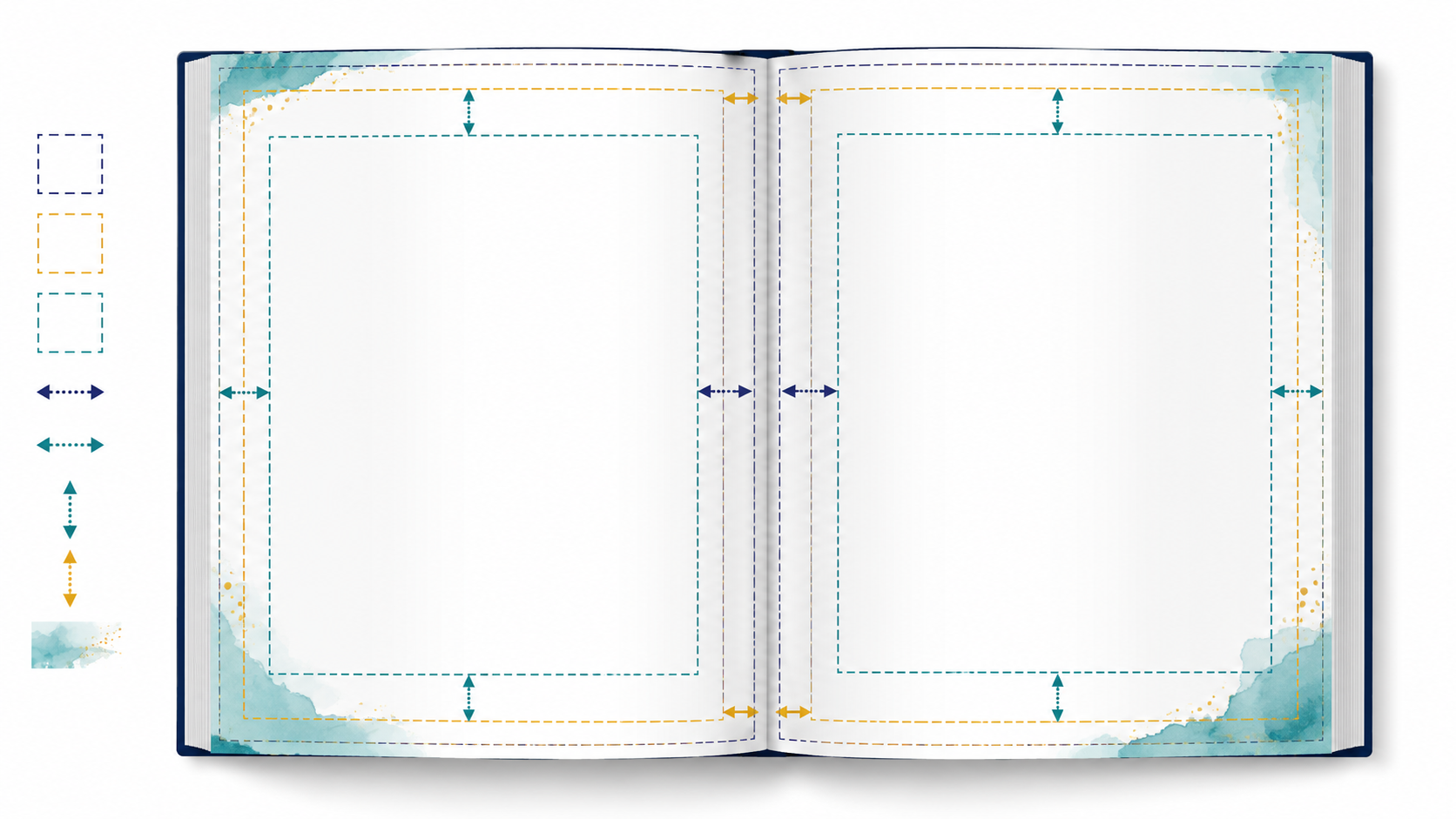
The KCanvas KDP PDF Auditor can check interior files for page size, bleed, margins, unsafe zones and print readiness before the PDF is uploaded to KDP.
This does not replace the KDP previewer or your own visual inspection. It adds an earlier checkpoint where mistakes can be corrected before submission.
Checkout our guide on KDP Trim Size, Bleed and Margins Explained: A Beginner’s Formatting Guide
Step 8: Publish the First Book Before Finishing All Three
The three-book test does not require you to complete all three books before receiving any feedback.
A better sequence is:
- research and position all three;
- complete the first book;
- publish it;
- begin the second while observing the first;
- use early lessons to improve the second and third.
This protects you from repeating the same mistake three times.
For example, the first book may reveal that:
- the cover attracts the wrong age group;
- the subtitle is too vague;
- the price is difficult to sustain;
- the interior requires more illustrations;
- customers prefer a larger trim size;
- one subtopic receives more interest than expected.
Planning the portfolio together gives you direction. Producing it sequentially gives you room to learn.
What to Measure During the First 90 Days
Do not judge the book only by whether it has reached $1,000.
The first 90 days should help you diagnose where the publishing system is working or failing.
Track:
- orders;
- royalties;
- advertising spend;
- advertising-attributed sales;
- organic sales;
- refund or return patterns where visible;
- reviews;
- page reads for eligible Kindle books;
- performance by marketplace;
- performance by format;
- changes after cover, price or metadata updates.
KDP’s Reports Dashboard includes estimated royalties, orders, top-earning books, formats and marketplaces. It also allows publishers to compare books and download reports. Amazon Ads reporting is separate because the advertising console focuses on activity attributed to ads, whereas KDP Reports contains broader book activity.
Keep a weekly record instead of relying on memory.
Use the Results to Diagnose the Problem
Sales alone do not explain why a book is succeeding or failing.
Use the available evidence to form a diagnosis.
Little or no visibility
Possible causes include:
- weak search positioning;
- limited demand;
- unsuitable keywords;
- a new book with little sales history;
- insufficient promotion.
Visibility but few clicks
Possible causes include:
- an unappealing cover;
- an unclear title;
- a price that feels wrong;
- poor alignment with the shopper’s search.
Clicks but few sales
Possible causes include:
- a weak description;
- an unconvincing preview;
- poor reviews;
- a mismatch between cover promise and interior;
- insufficient perceived value.
Sales but little profit
Possible causes include:
- low royalty per sale;
- high advertising costs;
- expensive production;
- an unsustainable list price;
- too many discounted or low-margin formats.
One title sells while the others do not
This may reveal a stronger subtopic, buyer group, format or positioning angle.
The purpose of measurement is not to defend the original idea. It is to decide what deserves further investment.
When to Improve, Expand or Stop
After collecting enough information, choose one of three actions.
Improve
Improve the existing book when there is evidence of interest but the packaging or conversion appears weak.
Possible changes include:
- a clearer subtitle;
- a stronger cover;
- a better description;
- corrected formatting;
- a more appropriate price;
- improved A+ Content;
- more accurate keywords.
Expand
Develop the next related book when the first title demonstrates that the audience and angle deserve further investment.
Expansion may involve:
- a sequel;
- a narrower subtopic;
- an advanced edition;
- a companion workbook;
- another age group;
- a different but complementary format.
Stop
Stop investing when the evidence remains weak after reasonable testing and improvement.
Stopping is not necessarily failure.
It prevents you from spending months building a catalogue around an unsupported assumption.
Advertising Cannot Rescue a Weak Book
Amazon Ads can place books in visible shopping locations, including search results and product-detail pages. Sponsored Products use a cost-per-click model, meaning advertisers pay when shoppers click.
Ads can help you:
- generate visibility;
- test keywords;
- collect click and sales data;
- reach readers browsing similar products.
They cannot permanently solve:
- a weak concept;
- a confusing cover;
- an uncompetitive book;
- poor reviews;
- an interior that disappoints buyers;
- negative economics.
Before running ads, calculate the most you can reasonably spend to acquire one sale.
For example, when the book earns a $4 royalty and your advertising cost per sale is $5, each advertised sale creates a $1 loss before other expenses.
That loss may occasionally be accepted as part of a controlled launch test, but it should not be mistaken for a profitable sales system.
The KCanvas Portfolio Loop
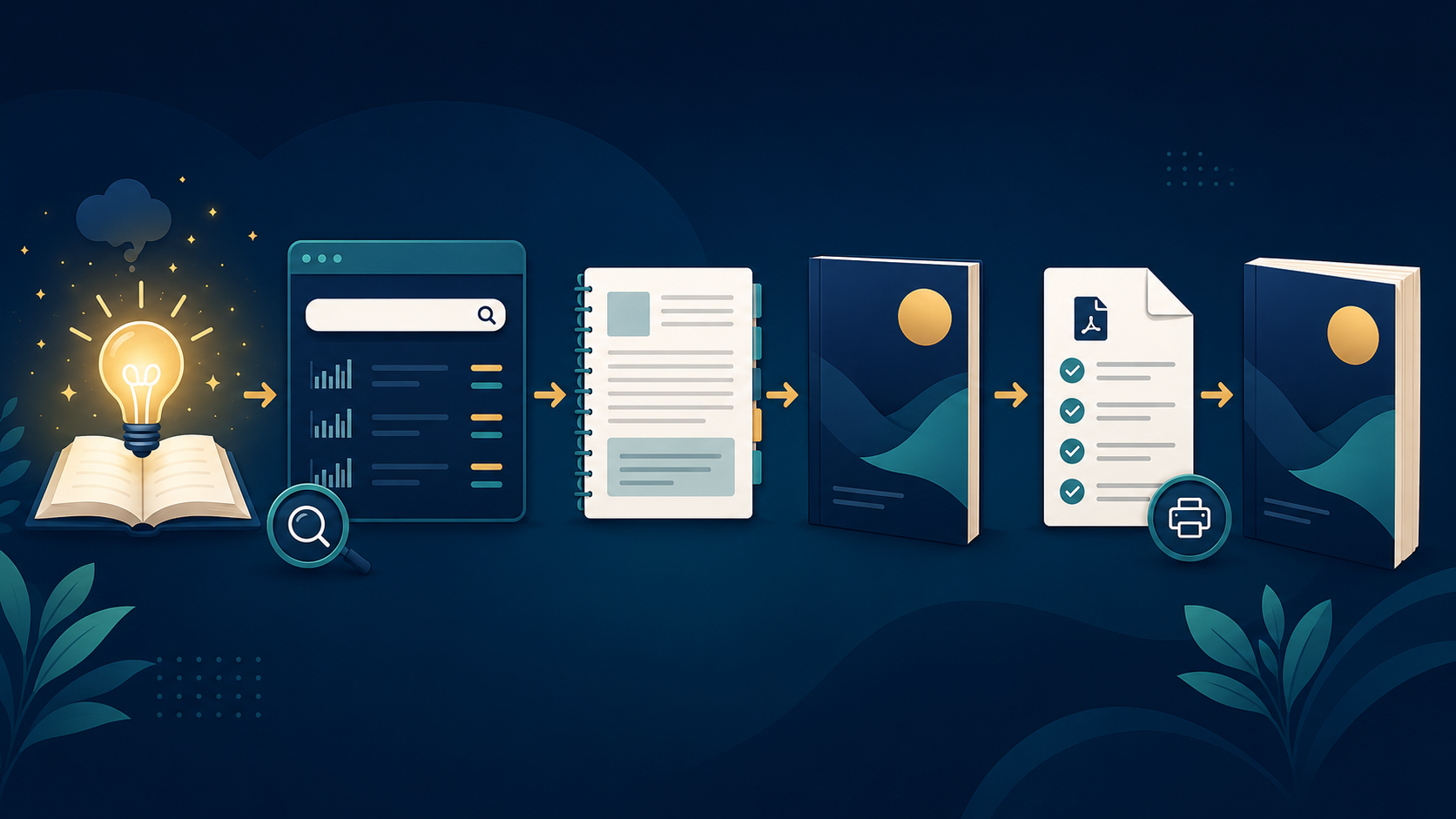
The entire process can be summarized as a six-stage loop:
1. Research
Use niche hunting, keyword research and suggestion expansion to identify an audience and connected needs.
2. Position
Define the reader, promise, title, subtitle and distinguishing angle for each book.
3. Build
Create the table of contents, manuscript, visuals and interior through a controlled production process.
4. Audit
Review the concept, content, metadata and print-ready PDF before upload.
5. Measure
Track royalties, orders, expenses, advertising and title-level performance.
6. Expand or correct
Use real results to improve the product, produce a related title or stop investing in the angle.
Then repeat the loop with better information.
KCanvas is designed around a similar connected workflow: researching book ideas, planning titles and structures, generating publishing assets and auditing PDFs before upload.
The value is not simply producing a book faster.
It is reducing the number of disconnected decisions made without a shared strategy.
Your First-$1,000 Planning Worksheet
Complete this worksheet before producing the first book.
Financial target
- Cumulative royalty goal: $1,000
- Target completion period:
- Maximum production budget:
- Maximum advertising-test budget:
- Required profit after expenses:
Book economics
- Expected format:
- Expected page count:
- Expected list price:
- Estimated printing cost:
- Estimated royalty per sale:
- Sales required for $1,000:
- Sales required to recover production costs:
Audience
- Primary reader:
- Primary buyer:
- Main problem or desire:
- Evidence of demand:
- Repeated customer complaints:
- Main competing alternatives:
Three-book test
- Book One and its promise:
- Book Two and its promise:
- Book Three and its promise:
- Why each book deserves to exist:
- What can be reused across the series:
- What must remain unique:
Measurement
- Publication date:
- First review date:
- 30-day review date:
- 60-day review date:
- 90-day review date:
- Metrics to track:
- Conditions for improving:
- Conditions for expanding:
- Conditions for stopping:
A Worked Example
Imagine a publisher planning three related educational books for children.
The estimated royalty is $4 per paperback.
The cumulative target is $1,000.
The required total sales are:
$1,000 ÷ $4 = 250 copies
The publisher allocates the target like this:
| Book | Target sales | Royalty per sale | Royalty contribution |
|---|---|---|---|
| Broad introductory book | 100 | $4 | $400 |
| Focused topic book | 75 | $4 | $300 |
| Companion topic book | 75 | $4 | $300 |
| Total | 250 | $1,000 |
The publisher does not assume the distribution will happen exactly this way.
One title may sell 170 copies while another sells 20.
The table is useful because it reveals the size of the task before production begins.
The publisher can now ask better questions:
- Is this audience capable of supporting 250 total purchases?
- Are the books different enough?
- Is a $4 royalty realistic?
- How much can be spent before the plan stops being profitable?
- Which book should be tested first?
- What evidence would justify publishing the second and third?
That is a publishing plan.
“Upload books until something sells” is not.
What I Would Do with a $500 Starting Budget
I would not spend the entire amount producing three books at once.
A more controlled allocation might look like this:
| Use | Proposed amount |
|---|---|
| First book cover and interior assets | $150 |
| Editing or proofreading support | $100 |
| Proof copies and revisions | $50 |
| Research and production tools | $50 |
| Controlled advertising test | $100 |
| Reserve for corrections | $50 |
| Total | $500 |
The exact amounts depend on the book type and the work you can complete yourself.
A highly illustrated children’s book may require considerably more. A carefully produced black-and-white puzzle book may require less.
The important principle is to retain a correction reserve.
Do not spend everything reaching publication and leave nothing for fixing the product after receiving feedback.
The Real Purpose of the First $1,000
The first $1,000 is valuable, but the money is not the only outcome.
By the time you reach it, you should understand:
- which audience responds to your work;
- which book angle attracts buyers;
- how much you earn per sale;
- what it costs to produce a title;
- whether advertising is sustainable;
- how long production takes;
- which parts of the workflow can be repeated;
- which mistakes reduce conversion;
- whether the audience can support more books.
Without those lessons, earning $1,000 once may be difficult to repeat.
With them, even a slower first portfolio can become the foundation for stronger future decisions.
Final Thoughts
Your first $1,000 on KDP is not primarily a motivation challenge.
It is a sequence of assumptions that must be tested:
- the audience exists;
- the audience buys books;
- your angle matters;
- your packaging attracts attention;
- your content fulfils the promise;
- your royalty supports the business;
- your production process maintains quality;
- related books can serve the same reader.
Begin by calculating how many sales you need.
Then identify one audience capable of supporting three distinct books.
Research all three, publish the first, measure the result and allow real evidence to influence what you create next.
KCanvas can support this workflow from niche and keyword research through title development, book planning, content creation and final PDF auditing.
The goal is not to publish as many books as possible.
The goal is to build the smallest portfolio that teaches you what can be repeated profitably.